Most content creators are trapped in a false dichotomy: quality or quantity. The truth? You can have both, if you understand the system behind scalable content production.
Takeaway: Publishing 50 articles in one day isn't about working faster, it's about building a repeatable content system that separates research, creation, and optimization into parallel workflows.
The Real Bottleneck Isn't Writing
Here's what nobody tells you: writing is only 20% of content production. The other 80%? Research, keyword clustering, content briefs, SEO optimization, and quality control. Most creators do these sequentially, one article at a time. That's why they're stuck at 2-3 posts per week.
The solution isn't writing faster. It's restructuring your entire workflow.
1. Keyword Clustering: Your Foundation
Start with a bulk article generator approach, but intelligently. Pull 50-100 related keywords in your niche and group them into topical clusters. This isn't random, you're mapping the semantic relationships Google actually cares about.
Each cluster becomes one article. This prevents keyword cannibalization and builds topical authority simultaneously.
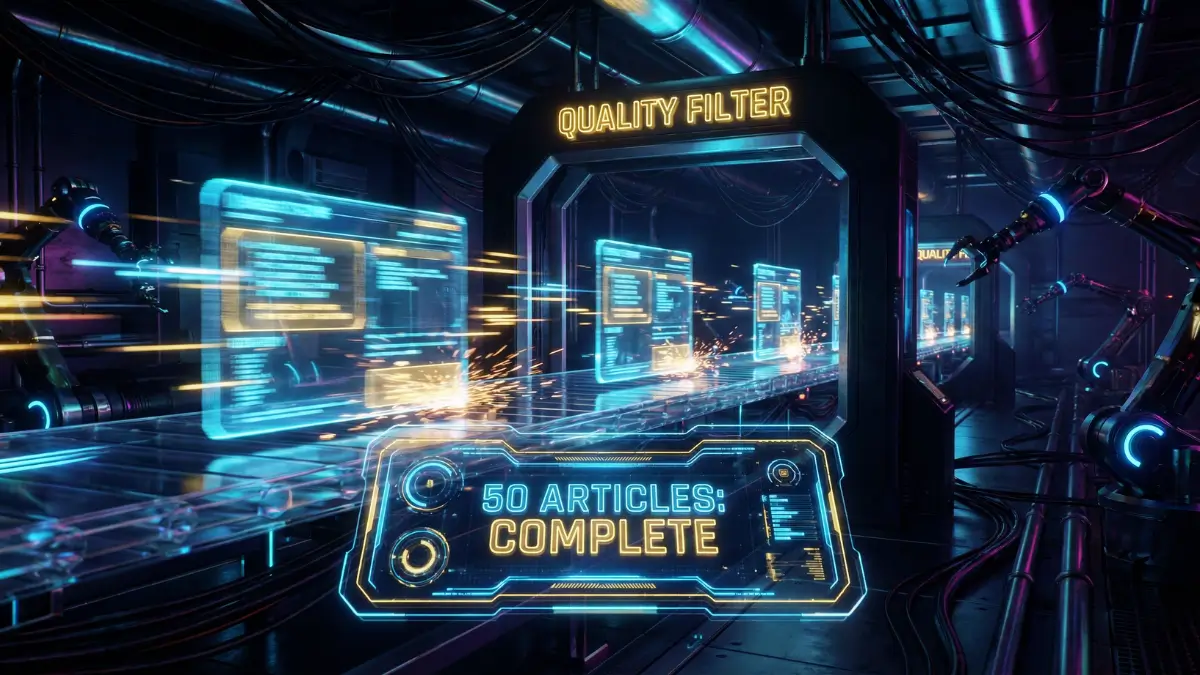
2. The Assembly Line Method
Break content creation into stations:
- Station 1: Batch all research in 2-hour blocks. Create skeletal outlines for all 50 articles.
- Station 2: Generate first drafts. Use AI for speed, but inject your expert insights at strategic points.
- Station 3: Human editing layer. Focus on adding unique examples, contrarian viewpoints, and actionable specifics AI can't provide.
- Station 4: SEO optimization pass. Meta descriptions, internal links, schema markup, all in one sweep.
The secret? You never context-switch. Your brain stays in "research mode" or "editing mode" for hours, dramatically reducing cognitive load.
3. The Quality Control Framework
Here's where most bulk content fails: no quality threshold. Implement a three-tier filter system:
a. Readability Score: Hemingway grade 8 or lower. If it reads like a textbook, rewrite.
b. Expertise Injection: Each article must contain at least one insight that demonstrates domain expertise. Generic advice gets rejected.
c. Value Density Test: Can you remove 30% of words without losing meaning? If yes, cut them.
4. Distribution Automation
Publishing 50 articles manually is insane. Pre-schedule everything using your CMS. Stagger releases over 2-4 weeks to avoid Google's "sudden spike" penalty and give your audience time to engage.
Set up automatic internal linking between related cluster articles. This compounds SEO value across your entire content library.
The Shortcut: Tools Built for Scale
This workflow works, but it's still labor-intensive. That's where a bulk article generator like SeoScribe changes the equation. It's specifically designed to produce expert-level, human-like content at scale, without the robotic tone that kills engagement. The platform handles the heavy lifting of research, structure, and SEO optimization while preserving that critical human insight layer.
Why This Works When Others Fail
Traditional content creation is serial processing. This system is parallel processing. You're not doing 50 times the work, you're doing the same work once, then applying it across 50 canvases.
The compound effect is staggering. 50 articles means 50 ranking opportunities, 50 internal linking nodes, and exponential topical authority in Google's eyes.
The One Thing Nobody Mentions
Volume amplifies quality, but only if you maintain standards. One exceptional article gets you one ranking. Fifty exceptional articles get you category dominance because you're covering the entire semantic landscape of your niche.
Final Word
Publishing 50 high-quality articles in 24 hours isn't about working harder, it's about building a system that makes quality scalable.